ArtsenPool
A platform where hospitals post temporary assignments and self-employed doctors respond themselves, from the first notification to confirmed hours.
- Client
- ArtsenPool, platform for temporary assignments in healthcare
- What we did
- UI design, web design and building the whole platform, from public site to three portals
- Technology
- Next.js
- Status
- Still in development, not launched yet
- Site
- artsenpool.com ↗
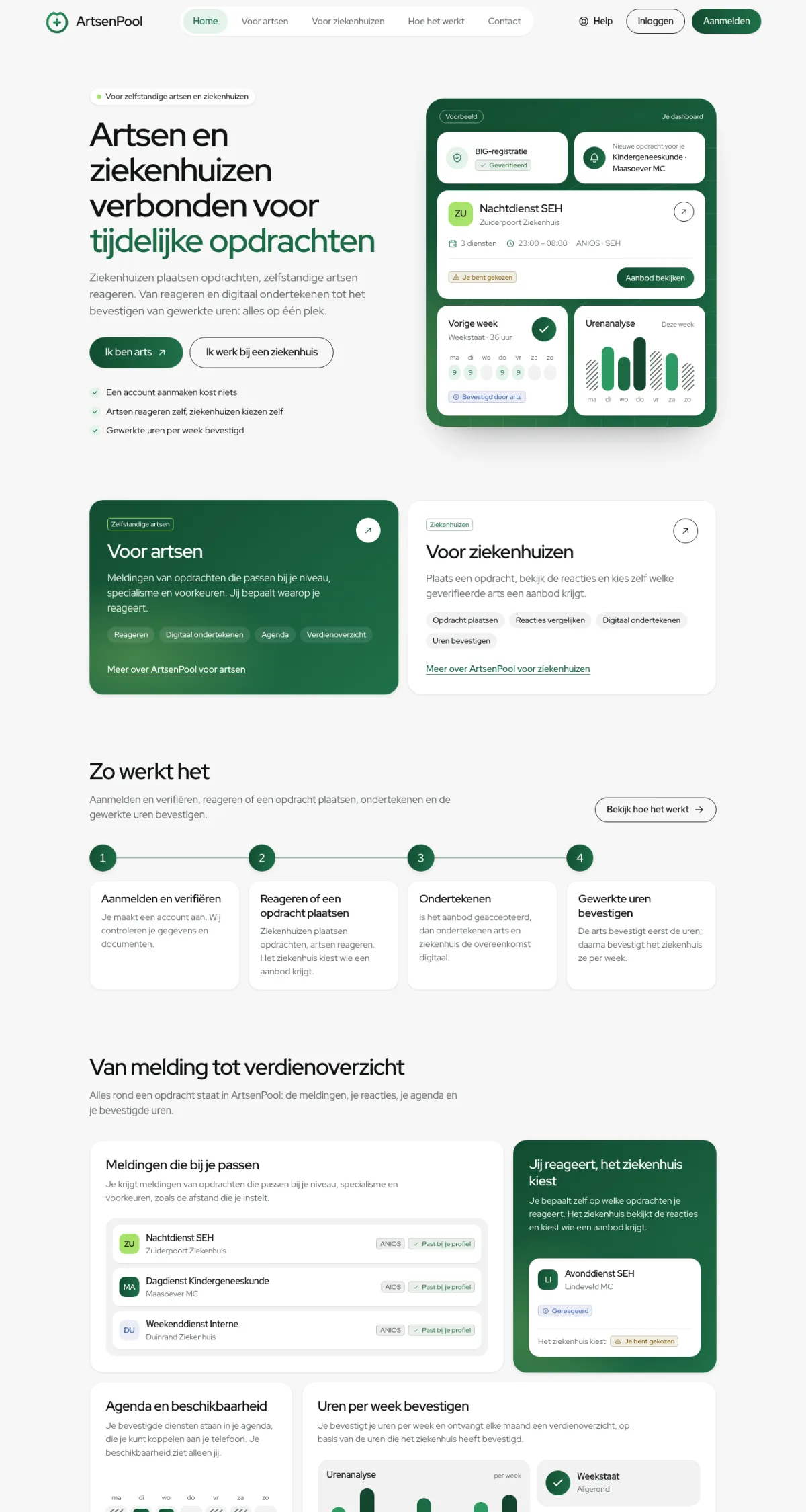

Counted on artsenpool.com, 24 October 2026
| Fact | Result | How we checked |
|---|---|---|
| Portals | 3: for doctors, for hospitals and for the ArtsenPool team | The How it works page, read on 24 October 2026; the portals themselves checked in the code |
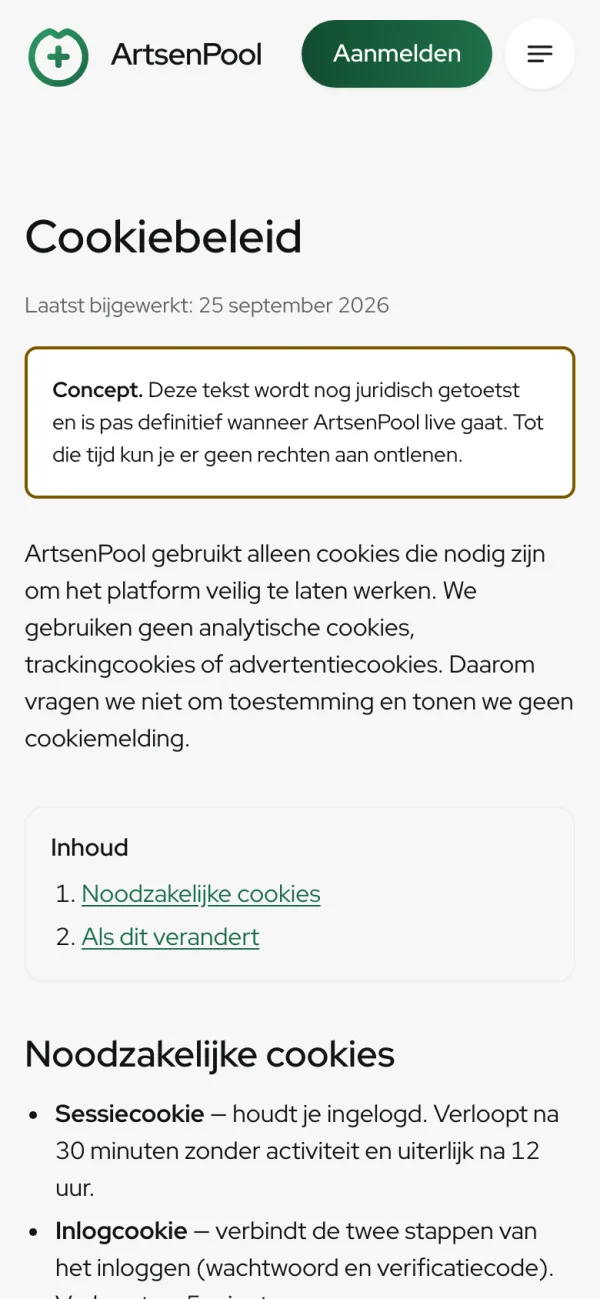
| Cookies | Only a session cookie and a login cookie, no tracking cookies | The site's cookie policy, read on 24 October 2026 |
| Public pages | 15 | Every page requested on 24 October 2026; all 15 reachable |
| Languages | Dutch | Language setting of the site, checked on 24 October 2026 |
| Load time on a phone | 1.7 s | Our own measurement on 24 October 2026: phone size, slow connection, empty cache, median of three runs. Google rates up to 2.5 s as good |
| Status | Still in development, not launched yet | The How it works page, read on 24 October 2026 |
Hospitals with open shifts, doctors who choose for themselves: one place for both.
ArtsenPool brings self-employed doctors and hospitals together for temporary assignments. Hospitals post assignments, doctors respond. From responding and signing digitally to confirming the hours worked, everything happens in one place.
The platform is for self-employed doctors, from junior doctors and doctors in specialist training to researchers and specialists, and for hospitals. In between sits an ArtsenPool team that checks accounts and assignments and helps when doctor and hospital disagree about hours. Creating an account is free.
We designed and built the whole platform: a public site of 15 pages and, behind the login, three portals, for doctors, for hospitals and for the team that runs it.
We are honest about the status, in the site's own words: ArtsenPool is still in development. Digital signing and invoicing through the platform will only start once the legal and tax review is complete. For now, the site is kept out of search engines.
One platform, three portals.
What a doctor, a hospital and the ArtsenPool team can do after logging in. We describe it here in words; we do not show screens from behind the login.
| Portal | What it does | Why |
|---|---|---|
| Doctor | Search, filter and save assignments. Respond, with a different hourly rate if you like. A calendar with your own availability that you can link to your phone. Confirm hours per week, including extra work. A monthly earnings overview. A profile built in steps, with a preview of what a hospital sees. | Doctors decide for themselves what to respond to, and see in advance what others will see of them. |
| Hospital | Roles for manager, planner and finance; finance never sees doctors' details. Departments and inviting colleagues. Posting an assignment in steps, with a preview. The ranking, and finding a replacement when someone calls in sick. | Every colleague has an account of their own, with only the data that fits their role. |
| Admin | Review queues, a manual check in the BIG register (the Dutch register of healthcare professionals), suspending and reinstating with a stated reason, and a log of who did what. A sensitive action becomes a request that a second admin decides on. | Nobody on the team makes a far-reaching decision alone. |
| Account decision | A suspended doctor who logs in sees only the decision, the reasons and how to object. | Clarity, even when the answer is no. |
| Overnight | The platform prepares the weekly timesheets, sends reminders, closes expired offers, produces the earnings overviews and checks the BIG register again. | Recurring work happens by itself, and on time. |
Described from the platform's code, 24 October 2026
From notification to confirmed week, on both sides.
Doctor and hospital each follow four steps that fit together exactly. Digital signing will only start after the legal review.
| Step | Doctor | Hospital |
|---|---|---|
| Sign up | Fill in the profile and upload documents; a check in the BIG register. | Register the organisation; a check through the Dutch Chamber of Commerce (KvK). |
| Assignment | Notifications of suitable assignments, and responding in one click, with a different hourly rate if you like. | Post an assignment with shifts, level, specialty, requirements, accommodation and hourly rate. ArtsenPool checks it before doctors see it. |
| Choose and sign | Get chosen, accept the offer and sign digitally. | Rank up to five verified doctors; the offer works down the ranking. Then sign digitally. |
| Hours | Every Monday, confirm the hours of the previous week; an earnings overview on the 7th of the month. | Confirm the hours per week, after the doctor. |
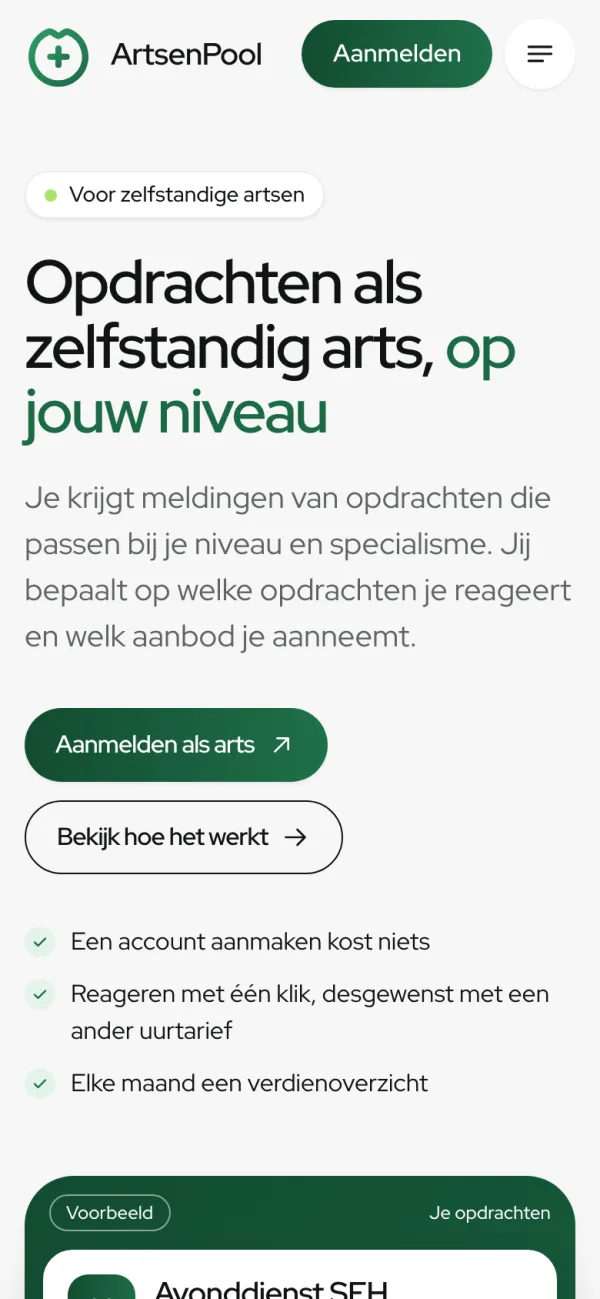
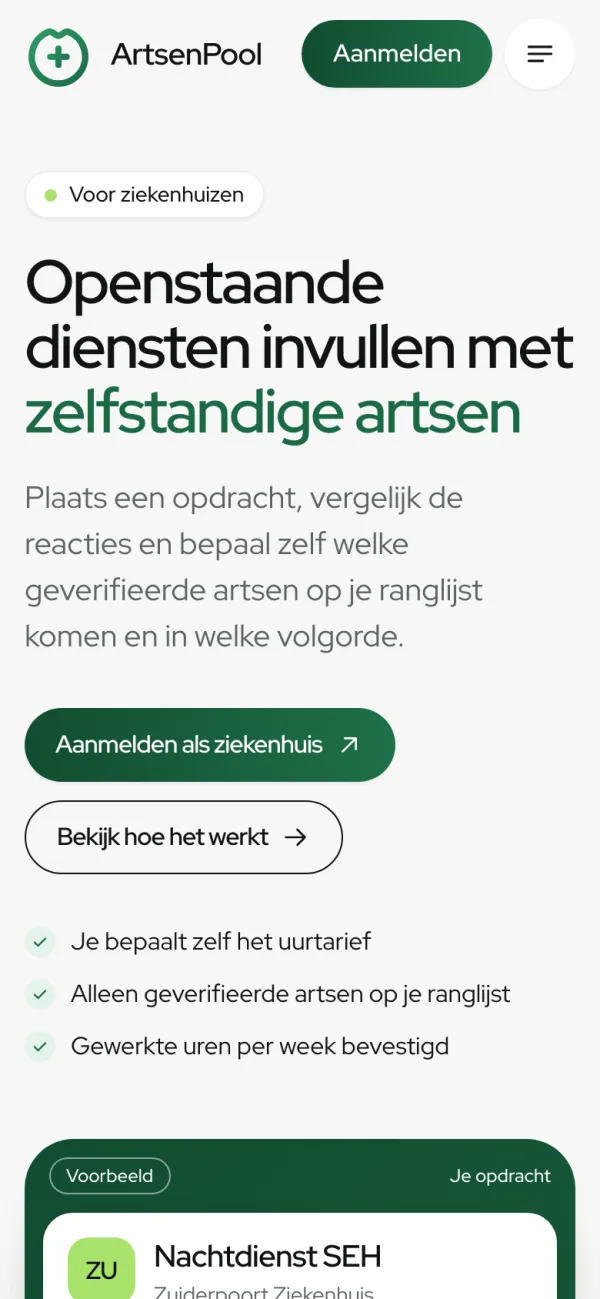
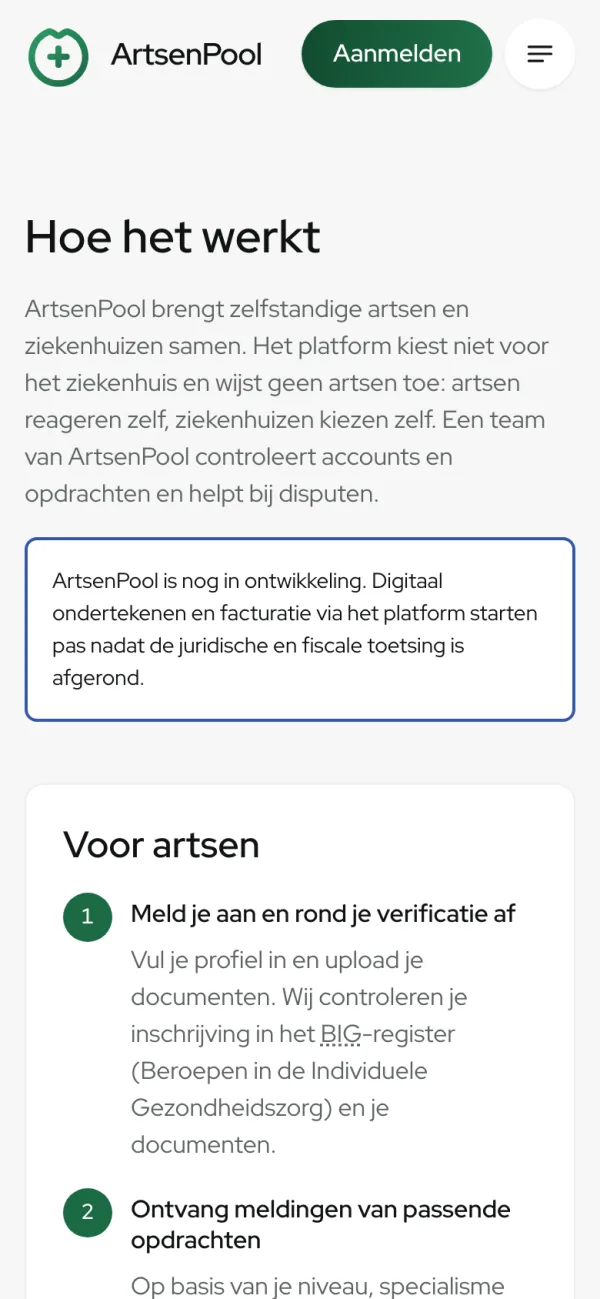
The doctor chooses, the hospital chooses. The platform does not.
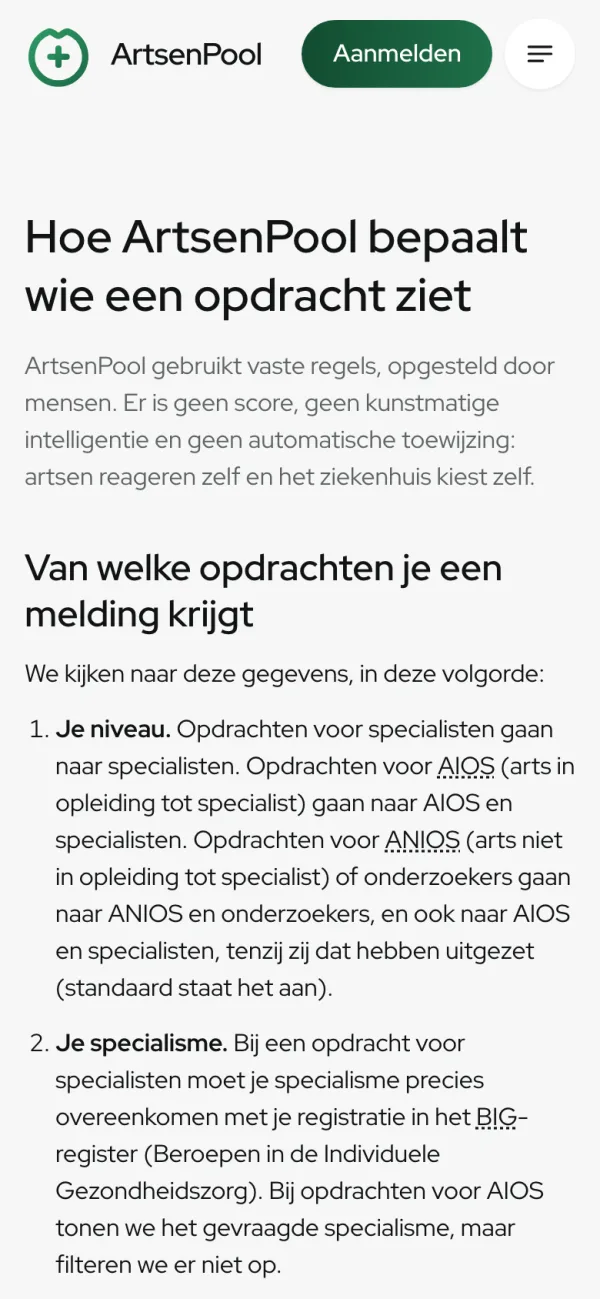
ArtsenPool works with fixed rules written by people: no score, no artificial intelligence and no automatic assignment. The rules are on a page of their own, for anyone to read.
| Rule | How |
|---|---|
| Level | An assignment for specialists goes to specialists; one for doctors in specialist training goes to them and to specialists; one for junior doctors also goes to everyone above, unless they switch that off. |
| Specialty | For specialists, the specialty must match the registration in the BIG register exactly. |
| Distance | 100 km by default, adjustable from 5 to 300 km. With accommodation, such as an on-call room or a hotel, distance does not apply. |
| Responding | Always possible, also beyond your own distance and before you are verified. Preferences only decide what you get notified about. |
| Ranking | The hospital ranks up to five verified doctors itself. If the first says no or does not respond in time, the offer goes to the next. Admins cannot assign anyone. |
| Why do I (not) see this? | Every assignment shows which rules decided whether you were notified. That outcome is kept for 12 months. |
| A person | Anyone who disagrees with an outcome can ask for a review by a staff member and gets an answer with an explanation within 14 days. |
| On the site | TransparencyHow it works |
A badge only after a check.
A hospital needs to know that a doctor is qualified. That is why ArtsenPool checks the BIG register itself, at four moments, along with the documents. Organisations and assignments are checked too.
| What | How |
|---|---|
| BIG register | At sign-up, periodically while shifts are planned, with an offer and before the doctor signs. |
| Documents | Diploma, professional liability insurance and registration with the Chamber of Commerce. |
| Badge | Only after both checks. Only verified doctors can be ranked, receive an offer and sign. |
| If the registration changes | If the register shows a removal, suspension or restriction, the verification lapses until the situation is resolved. |
| Hospitals | The organisation is checked through the Chamber of Commerce before it can post assignments. |
| Assignments | Every assignment is checked before doctors see it. |
| On the site | Frequently asked questionsFor hospitals |
In healthcare: as little data as possible, for as short as possible.
A hospital sees a doctor in steps, the site sets no tracking cookies, and whatever is no longer needed, the platform clears out itself every night.
| Topic | How | Where to read it |
|---|---|---|
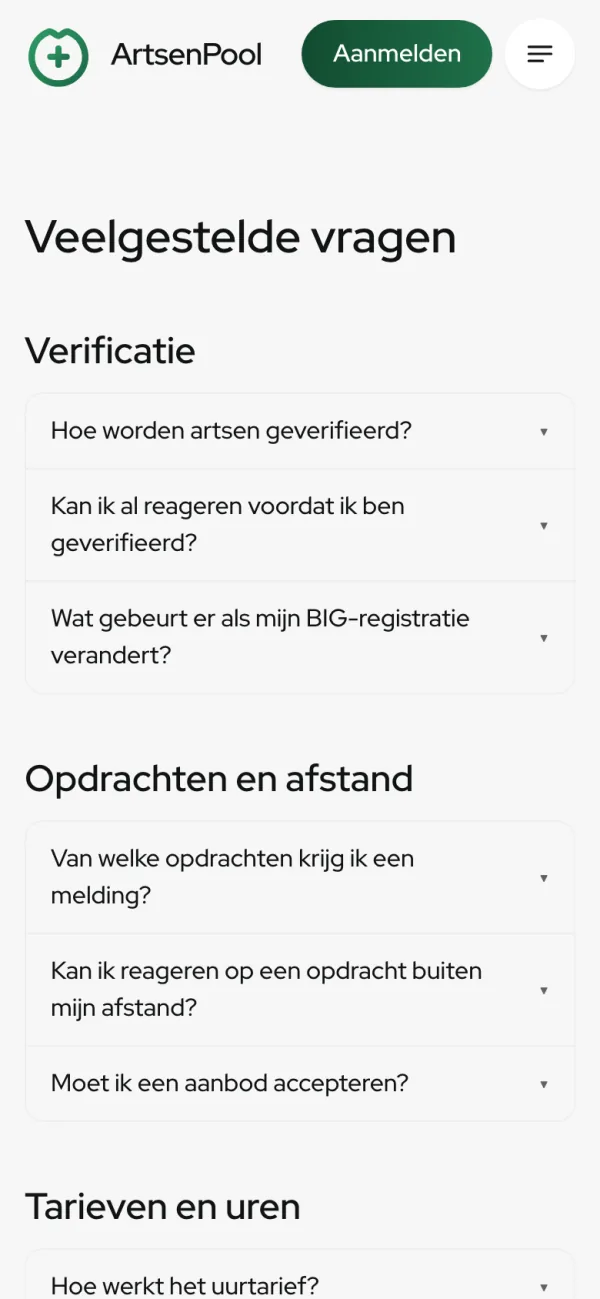
| Cookies | Only a session cookie (30 minutes without activity, 12 hours at most) and a login cookie (5 minutes). No analytics, tracking or advertising cookies, so no cookie banner either. | Cookie policy |
| Profile in steps | First a limited profile. Photo, graduation year and BIG number only after an accepted offer, email and phone only once everyone has signed. Date of birth and home address never. | Frequently asked questions |
| What not | No data about gender. | Privacy policy |
| Retention | Messages through the contact form for 12 months at most; financial data for 7 years, because tax law requires it. | Privacy policy |
| Clearing out | A clean-up run every night. A copy of an ID document stays for 7 days at most, a certificate of conduct file goes after the check, an interrupted upload after a day. Rejected responses disappear 4 weeks after the assignment closes, and a rejected sign-up is anonymised after 3 months. | In the code |
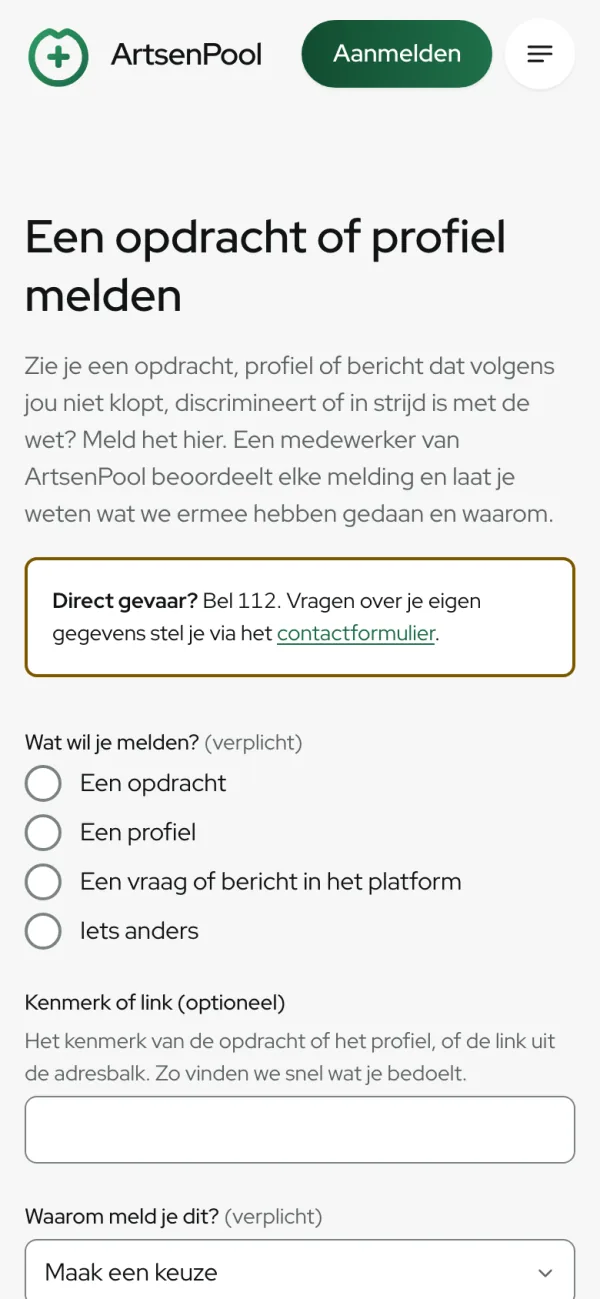
| Patient data | Every form warns: do not enter medical or patient data. In an emergency: 112. | Contact and Report |
| Reporting | Anyone can report an assignment, profile or message. A staff member reviews every report and explains what was done with it. | Report |
Admins log in with a passkey, and never decide alone.
Whoever can do the most gets the strictest access. Everything below is in the platform's code, or can be measured from outside.
| Part | How |
|---|---|
| Logging in | Two-step verification for all accounts. Doctors and hospital staff use a code from an app with recovery codes, or a passkey. |
| Admins | Only password plus passkey, no text message or separate code. Every change asks for the passkey again; that confirmation is valid for 10 minutes. |
| Four eyes | A sensitive action by an admin becomes a request. A second admin decides. |
| Passwords | Common and leaked passwords, in Dutch and English, are refused. |
| Roles | Access based on role, and a record of who views sensitive data. |
| Headers | Measured on the homepage: encrypted connections only, the site cannot be loaded in a frame, and camera, microphone, location and payments are switched off. Passkeys only work for the site itself. |
Headers measured on 24 October 2026
Verdant: green, with plenty of air.
The design is called Verdant and has a brand guide of its own. The logo mark is a heart with a plus inside, in a gradient from light to dark green. Lime is an accent that only appears on dark green.
 On light
#227D53The colour from the brand guide#1C6A45On the site, with enough contrast for text#124C31Start of the gradient on buttons#062612Dark areas#A9E26CAccent, only on dark green#111312Text

Next.js for the screens, our own server for the rest.
| Part | How |
|---|---|
| Website and portals | Next.js with React and Tailwind, and React Aria for components that work with a keyboard and a screen reader. |
| Server | NestJS: one application with a module of its own for each part, such as accounts, notifications, hours, disputes, verification, contracts and invoicing. |
| Background work | A separate worker with a queue on Redis. A task only enters the queue once the change has actually been saved. |
| Database | PostgreSQL, with Prisma. |
| Hosting | On Empireyo's own server, in a shielded environment and in containers without admin rights. Email currently goes to an internal catch-all inbox; nothing leaves the server. |
| Weight | The homepage weighs 390 KB in 27 requests, without a single photo: the sample dashboard at the top is plain HTML. |
| Accessibility | Target WCAG 2.2 AA. With every change, automated tests look for known errors and check the colour contrasts. The site itself says: partially compliant, an independent audit will follow before the launch. |
| Typeface | Red Hat Display, loaded from the site itself. |
Measured on 24 October 2026, on a phone with a slow connection and no cache
What it delivered
Doctors respond themselves, hospitals choose themselves, and anyone can read how.
Want to see more work?
Every client and what we made for them is on the work page.
Book an intro callSee all services